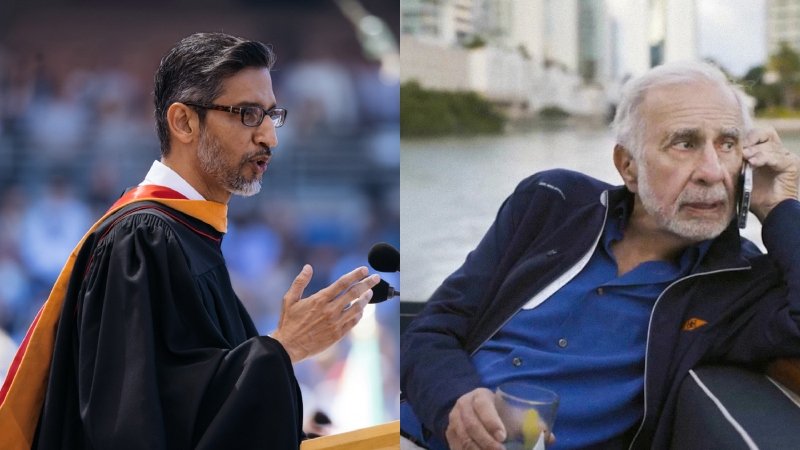
Sundar Pichai and Carl Icahn represent two very different paths to business success. Pichai built his career in technology and rose through Google to become CEO of both Google and its parent company, Alphabet. Icahn, meanwhile, became one of Wall Street’s best-known activist investors through strategic investments and efforts to influence the companies in which he holds significant stakes. Their careers developed in different worlds, but their names can be connected through an important event in the mobile technology industry: Google’s 2011 acquisition of Motorola Mobility.
Who is Sundar Pichai?
Sundar Pichai, whose full name is Pichai Sundararajan, is a technology executive who has worked at Google since 2004. He joined the company as the internet was entering another major period of growth and eventually became involved with important Google products, including Chrome. His career progressed through increasingly senior leadership positions before he became Google’s CEO in 2015. In 2019, he also became CEO of Alphabet, Google’s parent company.
Pichai’s rise is notable because he moved from product-focused leadership into one of the most influential executive positions in the technology industry. Today, his responsibilities extend across Google’s major businesses and Alphabet’s wider operations. Forbes currently estimates his net worth at about $1.6 billion, although that figure can change with Alphabet’s stock price and other financial factors.
Who is Carl Icahn?
Carl Icahn is an American investor best known for activist investing. Rather than simply purchasing shares and remaining a passive investor, Icahn has often sought to influence corporate decisions and push companies to change strategies, sell assets, restructure operations, or consider alternatives that he believes could increase shareholder value.
Icahn graduated from Princeton University and began his Wall Street career as a stockbroker. He later bought a seat on the New York Stock Exchange in 1968 and built a reputation as a powerful corporate investor. Today, he remains chairman of Icahn Enterprises, while his investment activities are carried out through Icahn Capital and related entities.
Forbes estimates Icahn’s current net worth at about $3.4 billion as of September 2026. Like other billionaire wealth estimates, that number can fluctuate over time.
What connects Sundar Pichai and Carl Icahn?
The connection between these two business figures is indirect rather than a documented long-term partnership. It centers on Google’s acquisition of Motorola Mobility in 2011.
At the time, Icahn and his affiliated entities owned approximately 11% of Motorola Mobility’s outstanding shares. In July 2011, Icahn and Motorola director Daniel Ninivaggi contacted Motorola CEO Sanjay Jha and expressed their view that the company should explore alternatives for its patent portfolio.
During the same period, Google was discussing Motorola’s business, patents, Android ecosystem, and potential strategic options. The SEC filing describing the transaction identifies Google’s Larry Page, Andy Rubin, Nikesh Arora, Kent Walker, and David Drummond among the executives involved in the discussions. Pichai is not identified in that filing as one of the executives negotiating the acquisition.
That distinction matters. Pichai was already an important Google executive during this period, but it would be inaccurate to say that he personally negotiated Google’s purchase of Motorola Mobility.
The Google-Motorola Mobility connection
Google and Motorola Mobility formally announced their acquisition agreement on August 15, 2011. Google agreed to pay $40 per share in cash, putting the total transaction value at approximately $12.5 billion. The deal was presented as a way to strengthen the Android ecosystem and enhance competition in mobile computing.
Motorola Mobility was particularly valuable to Google because of its position in the mobile industry and its extensive intellectual-property portfolio. The SEC record shows that Google’s discussions with Motorola included the company’s patents, intellectual-property litigation, Android, and strategic options for the business.
Icahn’s position made the transaction particularly relevant from an investment perspective. According to Motorola Mobility’s SEC filing, Icahn and related entities held 33,505,706 shares, representing approximately 11.39% of the company. The filing also records that Icahn indicated his intention to support the proposed merger.
The deal therefore brought together two very different forms of influence. Google approached Motorola as a technology and strategic acquisition, while Icahn’s involvement reflected the perspective of a major shareholder focused on the value of Motorola’s assets and shares.
Sundar Pichai’s role at Google during that period
Pichai was already progressing through Google’s leadership ranks when the Motorola transaction took place. His career at Google had begun in 2004, and his work eventually placed him at the center of important product decisions.
However, the timeline should be kept clear. Larry Page was Google’s CEO when the Motorola acquisition was announced in August 2011. The official transaction announcement quotes Page discussing the strategic rationale for the deal.
Pichai’s importance to Google grew substantially after this period. He became Google’s CEO in 2015 and later succeeded Page as CEO of Alphabet in 2019. His long-term influence has therefore come from leading Google’s technology business rather than from personally directing the Motorola transaction.
Pichai and Icahn: Two different paths to business influence
The careers of these two figures show how business influence can develop in very different ways.
Pichai’s influence comes primarily from technology leadership. His career has involved products, engineering, corporate strategy, and management at one of the world’s largest technology companies. His position at Alphabet gives him responsibility for a broad range of businesses and technologies.
Icahn’s influence has developed through investment and shareholder activism. His strategy has often involved taking substantial positions in companies and pushing management or boards to consider changes that could unlock value for shareholders. Icahn Enterprises describes itself as a diversified holding company with interests spanning investment, energy, automotive, real estate, food packaging, home fashion, and other businesses.
Their approaches are therefore fundamentally different: one is centered on leading a global technology organization, while the other is centered on investing capital and influencing corporate decisions.
Net worth and major achievements
As of September 2026, Forbes estimates Sundar Pichai’s net worth at approximately $1.6 billion. Forbes says Pichai has worked at Google since 2004 and owns a small stake in Alphabet, with much of his wealth connected to his compensation and Alphabet shares.
For Carl Icahn, Forbes currently estimates a net worth of approximately $3.4 billion. His wealth is primarily associated with investments and his long career in finance.
These figures should be treated as estimates rather than fixed amounts. Publicly reported billionaire net worth can change as stock prices, investments, and asset values move.
Key differences between Sundar Pichai and Carl Icahn
The biggest difference is their professional focus. Pichai is a technology executive whose career has been built around managing products, people, innovation, and corporate strategy at Google and Alphabet.
Icahn is an investor whose reputation was built through activist investing and shareholder influence. His career has involved taking positions in companies and attempting to change corporate decisions when he believes doing so can create additional value.
Their historical connection through Motorola Mobility is therefore more interesting precisely because they were operating from different positions. Pichai was part of Google’s broader leadership, while Icahn was a major Motorola shareholder.
Frequently asked questions
Who is Sundar Pichai?
Sundar Pichai is the CEO of Google and Alphabet. He joined Google in 2004, became Google’s CEO in 2015, and took over as Alphabet’s CEO in 2019.
Who is Carl Icahn?
Carl Icahn is an American investor and activist shareholder. He is chairman of Icahn Enterprises and has spent decades influencing companies through significant investments and shareholder activism.
Did Sundar Pichai and Carl Icahn work together?
There is no reliable evidence that they were direct business partners. Their connection is primarily indirect and relates to Google’s 2011 acquisition of Motorola Mobility.
What was Carl Icahn’s role in Motorola Mobility?
Icahn and his affiliates were major Motorola Mobility shareholders, owning approximately 11.39% of the company’s shares at the time documented in the SEC filing. He also pushed Motorola to explore alternatives for its patent portfolio.
Was Sundar Pichai Google’s CEO during the Motorola acquisition?
No. Google announced the Motorola Mobility acquisition in 2011 while Larry Page was Google’s CEO. Pichai became Google CEO in 2015.
How much was Google’s Motorola Mobility deal worth?
Google agreed to acquire Motorola Mobility for approximately $12.5 billion, paying $40 per share in cash.
Conclusion
Sundar Pichai and Carl Icahn followed very different routes to prominence. Pichai built a technology career at Google and eventually became the leader of Google and Alphabet, while Icahn developed his reputation through investing and shareholder activism. Their documented connection is indirect but significant: both were linked to the business environment surrounding Google’s 2011 acquisition of Motorola Mobility. Understanding that distinction makes the story more accurate and shows how technology leadership and activist investing can intersect in major corporate transactions.
For another look at how two public figures can build very different paths to success, explore our comparison of Marillyn Hewson and Igor Olenicoff.